
How Business Consultants in Chennai Solve Growth Challenges for SMEs

exxelo
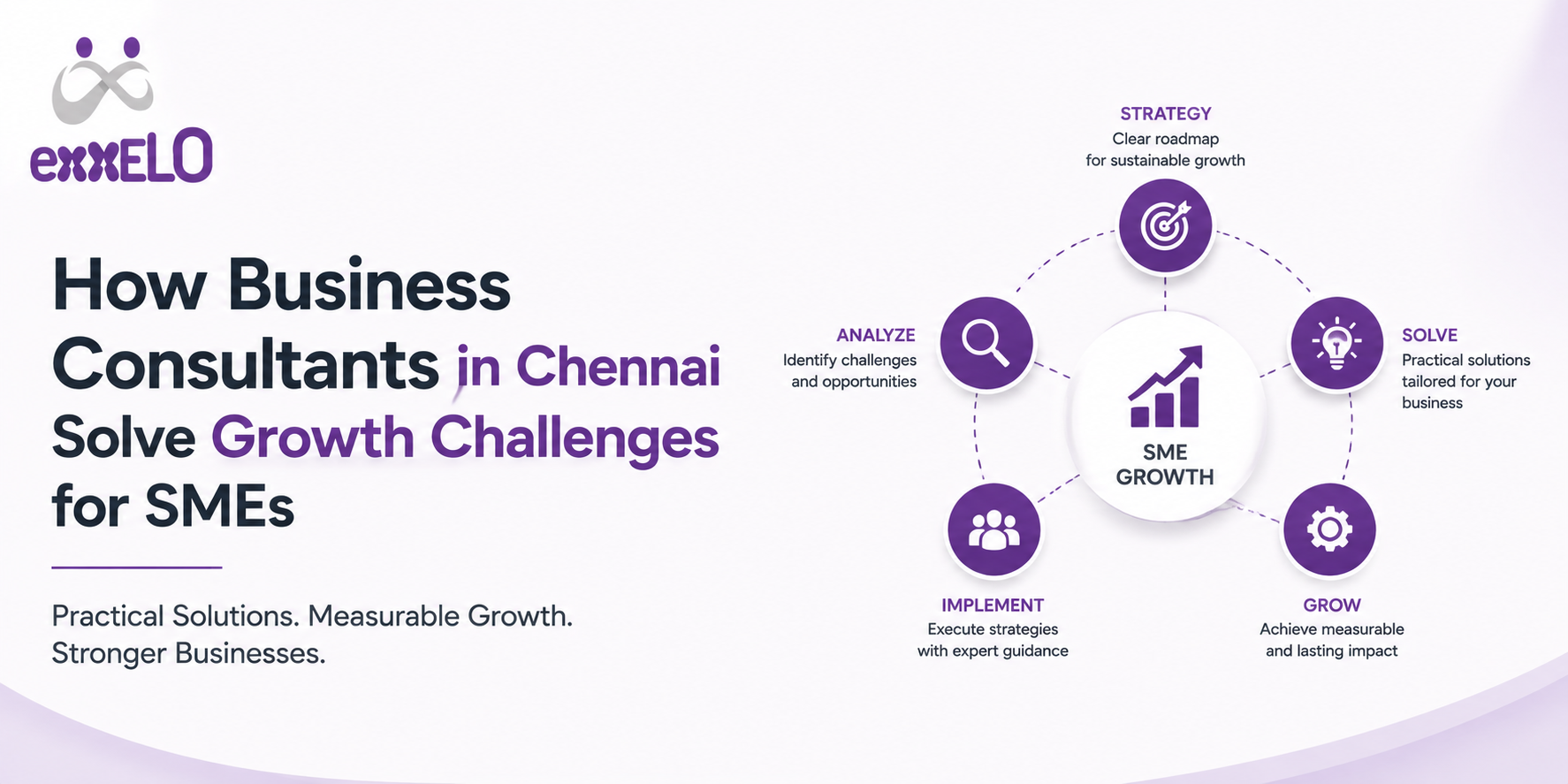
Business Consultants in Chennai help small and medium enterprises overcome the operational, financial, and strategic challenges that often prevent long-term growth. Small and medium enterprises across Chennai operate in one of South India’s most competitive business environments, competing for customers, skilled talent, and working capital against thousands of similar businesses. Growth rarely stalls because of a single mistake. It is usually the result of several small inefficiencies compounding over time until the business feels stuck despite genuine effort from the team. Working with business consulting experts in Chennai gives SME owners a structured way to diagnose these issues and build a realistic path forward. This article breaks down the most common growth challenges facing Chennai SMEs and explains exactly how a consultant works through each one.
The State of SME Growth in India Right Now
India’s micro, small, and medium enterprise sector now contributes close to a third of the country’s GDP and nearly half of its exports, employing more than 32 crore people nationwide. Tamil Nadu alone accounts for tens of lakhs of registered MSMEs—recent estimates place the figure around 62 lakh—putting it among the top three states for enterprise density Despite this scale, a recent industry analysis found that six in ten SMEs currently seeking capital are doing so to manage cash flow or service existing debt rather than fund expansion, pointing to a structural credit gap estimated at around thirty lakh crore rupees. These numbers tell a clear story: the opportunity for growth exists, but many businesses lack the internal systems and financial discipline needed to capture it. This is precisely where structured consulting support closes the gap between potential and performance.
Common Growth Challenges Facing SMEs
Limited Access to Structured Financial Planning
Many SMEs run on intuition rather than forecasts. Owners know roughly how much cash they have today but struggle to predict cash position three months out. Consultants introduce rolling forecasts, working capital tracking, and pricing reviews that reduce the guesswork behind every major spending decision.
Overdependence on the Founder
In a large share of Chennai-based SMEs, the founder remains involved in nearly every operational decision, from approving small purchases to reviewing routine client emails. This creates a ceiling on how fast the company can grow, since output is limited by one person’s available hours. Consultants help build organizational structures, delegate authority, and document processes so the business can function without constant founder involvement.
Weak Market Positioning
Businesses that compete purely on price often struggle to build sustainable margins, especially as input costs rise. A consultant typically runs a positioning exercise to identify what genuinely differentiates the company from competitors, then rebuilds messaging, pricing, and sales scripts around that differentiation instead of racing to the bottom.
Inefficient Hiring and Retention
Turnover in key roles is expensive and disruptive, particularly for smaller teams where every departure creates a visible gap. Consultants often review job descriptions, compensation benchmarks, and onboarding processes to identify where the hiring funnel is breaking down before recommending fixes.
Outdated Technology and Processes
Many SMEs still rely on manual spreadsheets for inventory, invoicing, or customer tracking long after the business has outgrown that approach. A consultant assesses which processes genuinely need automation first, prioritizing improvements where manual work creates the most errors or delays, rather than recommending a blanket technology overhaul.
Difficulty Scaling Beyond a Local Customer Base
Businesses that built their initial customer base through referrals often struggle to build a repeatable, scalable acquisition channel once that network is exhausted. Consultants typically map out a diversified customer acquisition strategy that reduces dependency on any single channel.
How the Consulting Process Actually Works
Step One: Diagnostic Assessment
Every engagement should begin with a thorough review of financial statements, operational workflows, team structure, and market position. This diagnostic phase identifies which problems are symptoms and which are root causes, since fixing the wrong issue first often wastes months of effort.
Step Two: Prioritised Action Plan
Rather than tackling every issue simultaneously, an effective consultant sequences recommendations based on impact and urgency. A cash flow problem, for example, typically takes priority over a rebrand, since a company that runs out of working capital will not survive long enough to benefit from better marketing.
Step Three: Implementation Support
Advice without execution rarely changes anything. Good consultants stay involved through implementation, whether that means sitting in on hiring interviews, reviewing new financial dashboards, or coaching managers through their first few delegated decisions.
Step Four: Measurement and Adjustment
Growth plans need regular review against real numbers. Consultants typically set up monthly or quarterly check-ins to compare actual results against targets, adjusting the plan as market conditions or internal capacity change.
Complementing Consulting With Leadership Development
Solving structural problems is only part of the equation. Many SMEs also need to build internal leadership capacity so that gains from consulting are sustained after the engagement ends. Pairing strategic consulting with leadership development programs across India helps middle managers grow into the roles founders are trying to delegate, ensuring the organisation does not simply revert to old habits once the consultant steps back. Businesses that invest in both structural fixes and people development tend to hold onto their gains far longer than those relying on strategy alone.
Why Local Market Knowledge Matters
A consultant unfamiliar with the Chennai business environment, its regulatory landscape, talent pool, and industry clusters will inevitably spend the early weeks of an engagement simply learning the terrain. Working with consultants already embedded in the local market shortens that ramp‑up period considerably, since they already understand which vendors, hiring channels, and compliance requirements are relevant to businesses operating in Tamil Nadu specifically. This local knowledge often translates into faster, more practical recommendations rather than generic advice copied from unrelated markets.
Signs Your SME Is Ready to Engage a Consultant
Not every business needs consulting immediately, but certain signals suggest the timing is right. These include revenue growth that has stalled for two or more consecutive quarters, a founder who has not taken meaningful time off in over a year, repeated hiring mistakes in the same role, or a leadership team that disagrees on basic strategic direction. Any one of these signals on its own may not warrant outside help, but two or more occurring together usually indicates that internal efforts alone are unlikely to resolve the underlying issue quickly.
Industries Where Consulting Delivers the Biggest Impact
Manufacturing and Ancillary Units
Chennai’s manufacturing base, particularly in automotive ancillaries and electronics, often struggles with inventory management, supplier negotiation, and production planning. Consultants working in this sector typically focus on lean process improvements and vendor consolidation to protect margins against rising raw material costs.
IT Services and Technology Startups
Technology companies in the city frequently face challenges around scaling delivery teams while maintaining service quality. Consultants in this space often help restructure project management practices and introduce clearer client communication protocols to reduce churn.
Retail and Consumer Businesses
Retailers competing against larger organised chains need sharper differentiation and tighter inventory control. Consultants typically review store-level unit economics and customer acquisition costs to identify where margins are being lost.
Professional and Financial Services
Firms offering accounting, legal, or financial advisory services often struggle with pricing their expertise correctly and building repeatable referral systems. Consulting engagements in this category tend to focus heavily on positioning and client retention strategy.
Measuring the Return on a Consulting Engagement
Business owners frequently ask how to judge whether a consulting engagement was worth the investment. The clearest way is to define measurable targets before the engagement begins, such as a specific improvement in gross margin, a reduction in employee turnover, or a target number of new customers acquired through a diversified channel mix. Reviewing these numbers at the midpoint and end of the engagement, rather than relying on a general sense of things feeling better, gives a far more accurate picture of impact. Businesses that skip this step often struggle to justify continuing the relationship, even when real progress has been made, simply because they never agreed on how success would be measured in the first place.
Frequently Asked Questions
How much does business consulting typically cost for an SME?
Costs vary widely based on the scope of the engagement, ranging from a focused project addressing a single issue to a retainer covering ongoing strategic support. Most consultants offer an initial diagnostic session to scope the work before quoting a fee, so businesses can evaluate the potential return before committing to a longer engagement.
Can a small business with fewer than twenty employees benefit from consulting?
Yes. In fact, smaller businesses often see faster results because changes can be implemented quickly without layers of internal bureaucracy slowing down execution. The key is choosing a consultant experienced with businesses of a similar size rather than one used to working exclusively with large enterprises.
How is consulting different from hiring a full-time strategy manager?
A consultant brings cross-customed industry experience and an outside perspective without the fixed cost of a full-time salary, making it a practical option for businesses that need strategic input periodically rather than daily. Many SMEs use consulting as a bridge until the business is large enough to justify a dedicated internal strategy role.
Conclusion
SME growth in Chennai is rarely limited by market opportunity. It’s far more often limited by internal systems, financial discipline, and leadership capacity that haven’t kept pace with ambition. A structured consulting engagement identifies exactly where those gaps exist and builds a realistic plan to close them, rather than offering generic advice that ignores the specifics of your business and industry. If your company is facing any of the challenges outlined above, connect with our business consultants in Chennai to start building a growth plan grounded in your actual numbers, team, and market position.
