Most organisations agree, in principle, that training matters. Far fewer can point to what a given programme actually changed. A workshop happens, feedback forms are collected, and within weeks the day-to-day reasserts itself and little is different. The budget was spent, but the business performed much as it would have anyway. That gap between activity and impact is not inevitable. It is usually the result of training that was generic, disconnected from the work, and treated as an event rather than a process. In this article we look at how customised corporate training programmes in Chennai bridge that gap: how a well-designed learning journey carries a new joiner from onboarding through to genuine business contribution, and how training can be tied to outcomes a leadership team actually cares about.
Table of Contents
• Why generic training rarely moves the needle • The onboarding to impact journey • What customised corporate training actually looks like • Connecting training to measurable outcomes • How to design a programme that delivers • Building a learning culture that lasts • Summary at a glance • Frequently asked questions
Why generic training rarely moves the needle
Off-the-shelf training is convenient, but convenience is exactly its weakness. A standard course is built for no one in particular. It cannot reflect your processes, your customers, your systems or the specific behaviours that drive performance in your business. Participants sit through content that is broadly true and rarely directly useful, and they struggle to apply it back at their desks. There is a well-documented reason application matters so much. Learning that is not reinforced and used fades quickly. The principle behind the forgetting curve, widely associated with the researcher Hermann Ebbinghaus, is that a large share of new information is lost within days unless it is revisited and applied. A single generic workshop, with no follow-through, is almost designed to be forgotten. Note for verification: the specific figures often cited for the Ebbinghaus forgetting curve should be confirmed against a primary source before this line is published as a hard statistic. The principle itself is well established.
The onboarding to impact journey
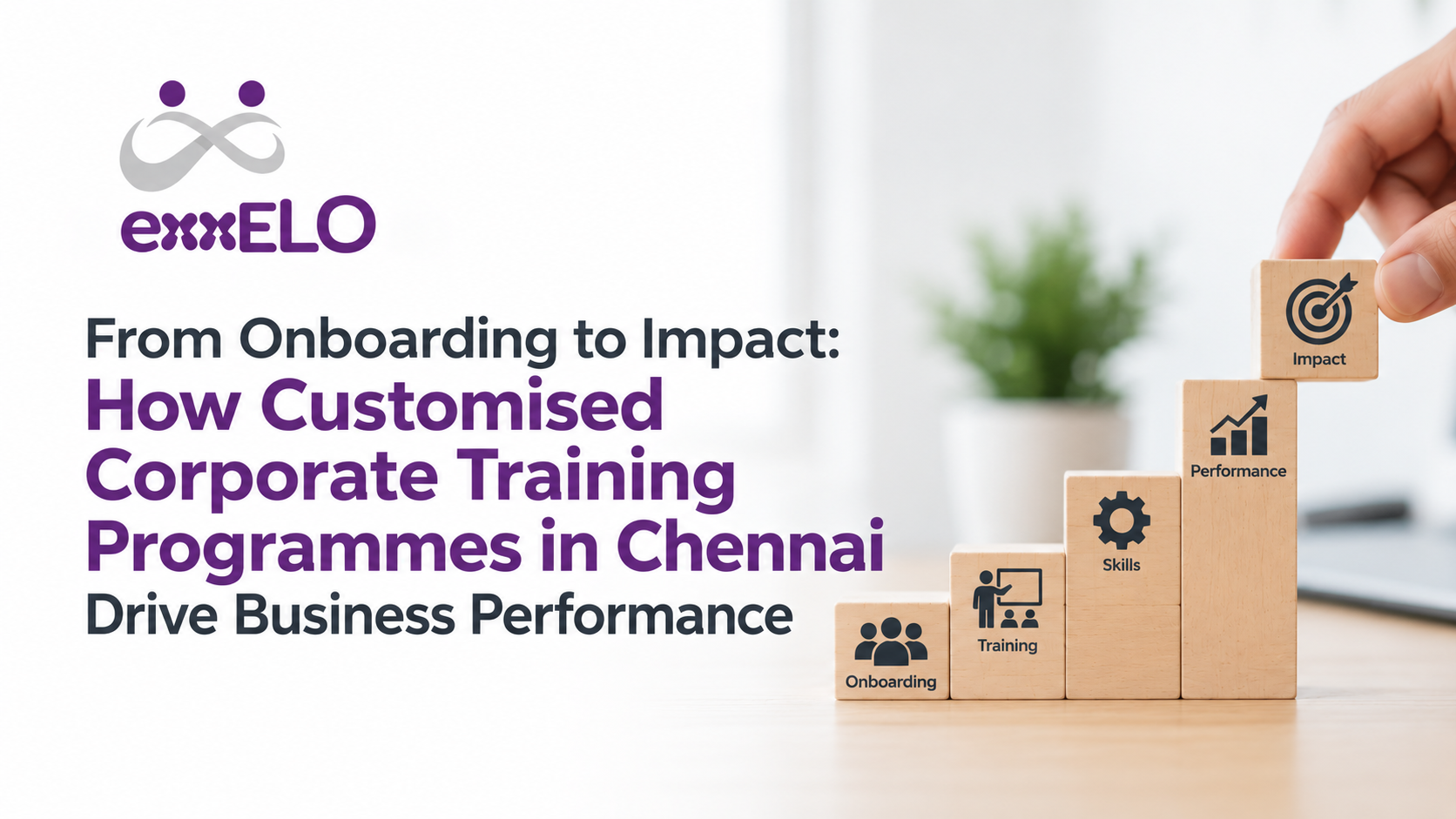
The most useful way to think about training is not as a calendar of courses but as a journey with a destination. That destination is impact: the point at which a person contributes fully and confidently to the business. Everything before it is about shortening the distance to that point.
Stage one: onboarding and orientation
Strong onboarding does more than complete paperwork. It gives a new joiner clarity on the role, the tools, the standards and the culture, and it builds early confidence. Organisations that invest in structured onboarding consistently see new hires reach productivity sooner and stay longer, because the first weeks set the tone for everything that follows.
Stage two: role-specific capability
Once oriented, people need the specific skills their role demands, taught in the context of how the work is actually done. This is where customisation earns its keep. Training built around your real processes and scenarios transfers directly to performance in a way that generic content cannot.
Stage three: reinforcement and mastery
Capability is not built in a single sitting. Spaced reinforcement, practice, coaching and on-the-job application turn knowledge into habit. This is the stage most often skipped, and it is the stage that determines whether the earlier investment pays off.
Stage four: measurable contribution
The journey ends where the business cares most: measurable contribution. A well-trained employee reaches proficiency faster, makes fewer errors, needs less supervision and adds value sooner. This is the point at which training stops being a cost line and becomes a performance lever.
What customised corporate training actually looks like
A customised programme starts from your business, not from a course catalogue. At Exxelo, training and development begins with understanding the outcomes you are trying to move, the roles involved and the gap between current and required capability. Only then is a programme designed. • Diagnosis first: a clear view of the skills gap and the business outcome it affects, rather than a course chosen in advance. • Content built around your context: your processes, systems, customers and real scenarios, so learning transfers directly to work. • Blended delivery: a mix of instructor-led sessions, practical exercises, coaching and reinforcement rather than a single event. • Built-in application: activities that require learners to use the skill on the job, where retention actually happens. • Measurement from the start: agreed indicators of success defined before the programme begins, not improvised afterwards.
Connecting training to measurable outcomes
Connecting training to measurable outcomes
How to design a programme that delivers
A programme that changes performance tends to share a few characteristics. It is anchored to a specific business outcome. It is customised to the organisation rather than borrowed from a shelf. It is delivered as a reinforced journey rather than a one-off event. And it is measured honestly against the indicators that matter. This is also where training connects to the wider picture. A capability gap is sometimes really a hiring gap or a process gap, which is why Exxelo links training with recruitment and business consulting so that the right people, the right structures and the right skills are developed together rather than in isolation.
Building a learning culture that lasts
The organisations that get the most from training are those where learning is continuous rather than occasional. A single strong programme lifts performance once. A culture of ongoing development compounds that lift year after year, and it becomes a genuine advantage in attracting and keeping good people, who increasingly choose employers that invest in their growth. If your training spend is not yet translating into visible business performance, the design is usually the reason, not the effort. Talk to Exxelo about building a customised programme that carries your people from onboarding all the way to measurable impact.
Summary at a glance
Onboarding and Orientation Faster confidence Earlier productivity Stronger retention Role-Specific Capability Skills taught in a real work context Direct transfer of learning to the job Reinforcement and Mastery Knowledge turned into practical habits Learning strengthened through practice and coaching Measurable Contribution Faster proficiency Fewer errors Value added sooner Measurement from the Start Training linked to measurable outcomes Focus on the results leaders actually care about
Frequently Asked Questions
What makes a corporate training programme customised rather than generic? A customised programme is built around your specific business outcomes, processes, systems and real scenarios, rather than delivered from a fixed course catalogue. Because the content reflects how work is actually done in your organisation, it transfers far more directly to performance. How do we measure whether corporate training worked? Agree the indicators of success before the programme begins. Depending on the role, these might include time to proficiency, productivity, output quality, sales performance, error rates or retention. Tracking these before and after turns training from an act of faith into a measurable decision. Why does so much training seem to be forgotten within weeks? Learning that is not reinforced and applied fades quickly, a principle long associated with the forgetting curve. A single workshop with no follow-through is almost designed to be lost. Reinforcement, practice and on-the-job application are what make training stick. How does training improve onboarding specifically? Structured onboarding gives new joiners clarity on the role, tools, standards and culture, and builds early confidence. This helps them reach productivity sooner and stay longer, because the first weeks set the tone for everything that follows. Can training really affect business performance, or just employee satisfaction? When it is designed around a specific outcome and measured properly, training moves real performance indicators such as productivity, sales results, error rates and time to proficiency. The key is designing for impact from the start rather than treating training as a standalone event. How is Exxelo's approach to corporate training in Chennai different? Exxelo starts with the business outcome and the capability gap, not a pre-chosen course. Programmes are customised, delivered as a reinforced journey, measured against agreed indicators, and connected to recruitment and consulting so people, structure and skills develop together. Talk to Exxelo. exxelo.org | +91 6383066746 | Besant Nagar, Chennai
Ready to turn training into measurable business performance? Talk to Exxelo about a customised corporate training programme built around your people, goals, and performance outcomes.
Talk to Exxelo